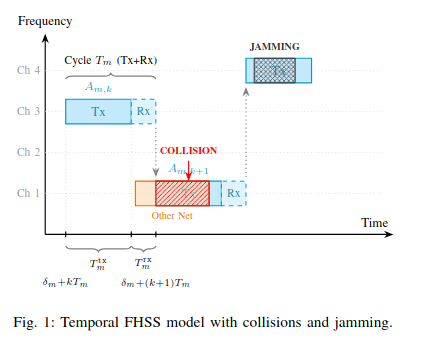
This paper investigates the decentralized coexistence of Frequency Hopping Spread Spectrum (FHSS) networks operating in contested environments where coordination, synchronization, and explicit ACKs are unavailable. Under these constraints, nodes rely solely on local and ambiguous binary observations, and collisions result in irreversible packet loss. We propose a lightweight distributed learning mechanism based on soft hopsets, where channels are progressively reinforced or discarded through reward-penalty updates. This induces a stochastic drift that drives networks toward implicit spectrum partitioning without any coordination or signaling. We derive an interpretable stability condition linking channel reliability to the reward–penalty ratio, providing insight into the emergence of stable hopsets under minimal observability. Monte Carlo simulations demonstrate that the proposed approach reduces collision probability by up to a factor of nine compared to fully random FHSS, even in high-load regimes with strong temporal overlap. These results show that coexistence and near-orthogonal spectrum usage can emerge from local interactions, making the approach particularly suitable for low-probability-of-intercept/detection (LPI/LPD) and denied environments.
IEEE MILCOM: Soft Hopset Learning for Coexistence of Uncoordinated FHSS Communication Networks