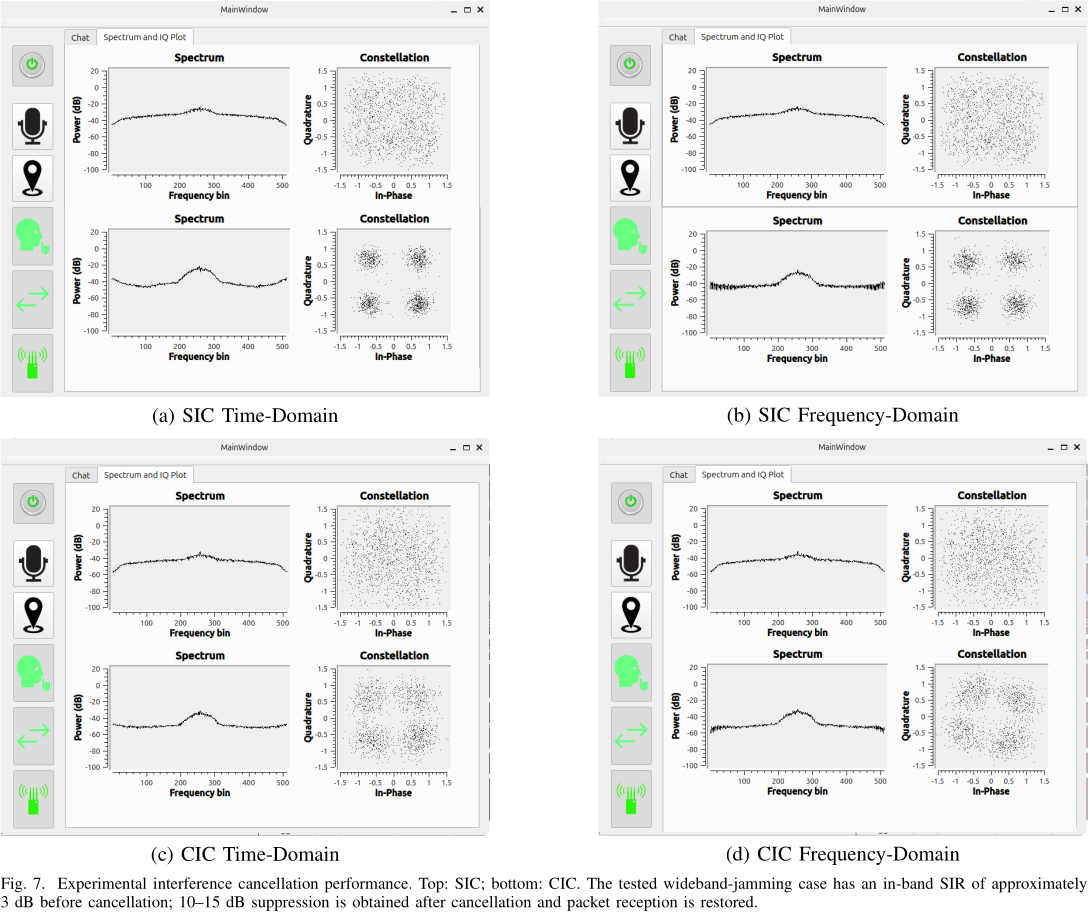
Full-duplex communication enables simultaneous transmission and reception on the same frequency channel, though its performance is severely constrained by self and co-site interference. This issue is particularly critical in tactical narrowband systems, such as those employing the NATO Narrowband Waveform (NBWF). This paper investigates digital self- and co-site interference cancellation techniques for NATO NBWF full-duplex operation. Both time-domain and frequency-domain approaches are analyzed through simulation, with complementary validation using SDR experiments. Simulation shows improved BER robustness down to -50 dB SIR, with limited variation over the investigated range. On SDR hardware, the system achieves up to 40 dB of interference rejection in structured self-interference scenarios, while wideband noise-like jamming conditions result in 10–15 dB of suppression due to their non-coherent nature. Compared to the conventional low-complexity time-domain approach, the proposed method provides improved robustness to wideband interference while retaining the ability to represent frequency-selective interference channels. Finally, the practical integration of an electronic warfare (EW) jammer within the NATO NBWF software demonstrates interference-resilient packet reception under co-channel jamming conditions, enhancing physical layer robustness in contested tactical environments.
IEEE MILCOM: Digital Cancellation of Self and Co-Site Interference for Full-Duplex NATO Narrowband Waveform